
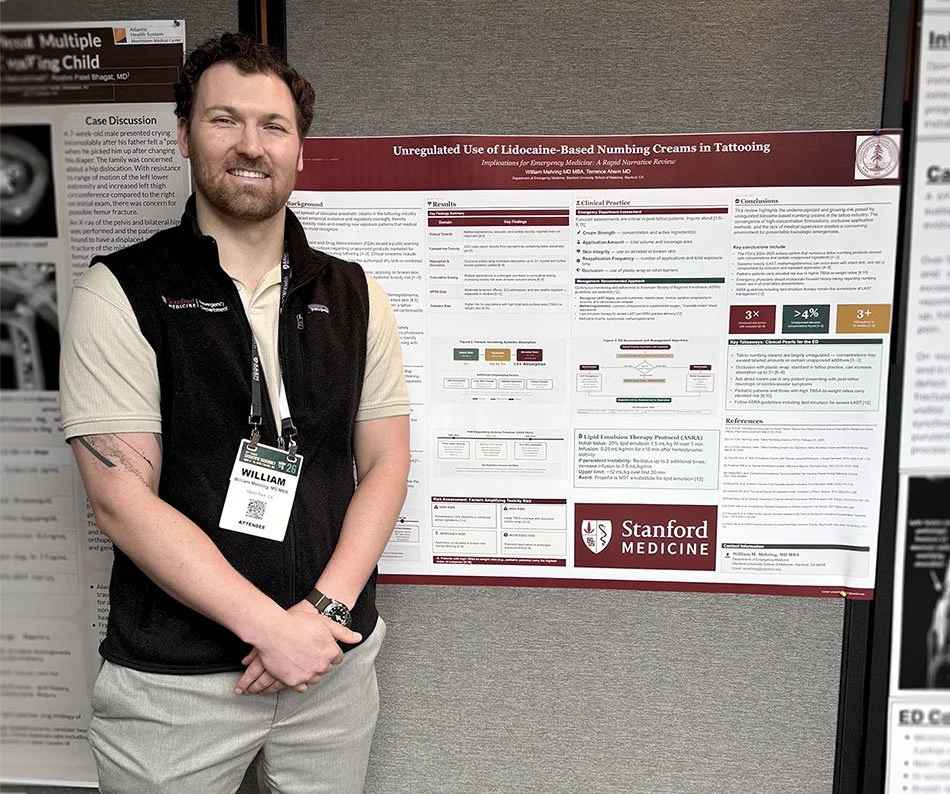
One of my favorite aspects of tattooing is the people I get to meet and the conversations that happen along the way. Spending several hours together in a tattoo session gives us plenty of time to talk about pretty much anything. Sometimes those conversations take unexpected turns.
And occasionally, they even inspire medical research.
I've had the pleasure of working with Will Mehring on several tattoos over the years. Will has a background in medicine, so naturally, our conversations often drift toward subjects where our professions overlap. You can read more about his tattoos and the stories behind them in my previous article, Tattoo Design for Will.
During one of our sessions, we ended up discussing something I've never been particularly fond of: numbing creams.
A Conversation About Numbing Creams
For those unfamiliar with them, numbing creams are topical anesthetics designed to temporarily reduce sensation in the skin. Many contain lidocaine, a local anesthetic commonly used in medicine.
From a tattoo artist's perspective, I've always been somewhat skeptical of these products. Not because I believe everyone should suffer through their tattoo session (I'm not quite that sadistic), but because certain creams can affect the condition and texture of the skin, potentially making the tattooing process more difficult.
I explained my concerns to Will, and he brought up another aspect I hadn't given much thought to: lidocaine is a medication, and like any medication, there are limits to how much can safely be used.
That led us to an interesting question. How much attention is actually being paid to the use of these products in tattooing?
Unlike medical procedures, where anesthetics are administered under established protocols, tattoo clients may purchase and apply numbing creams themselves, sometimes without professional guidance or a clear understanding of the potential risks.
What started as a casual conversation between a tattoo artist and his client turned into something worth investigating.
From the Tattoo Studio to Medical Research
Inspired by our discussion, Will decided to explore the subject further.
He went on to write a research paper titled Unregulated Use of Lidocaine-Based Numbing Creams in Tattooing: Implications for Emergency Medicine.
The paper addresses the potential medical concerns surrounding the use of lidocaine-based numbing products in tattooing, particularly when they are applied without appropriate guidance.
One important concern is that lidocaine can be absorbed through the skin. Depending on the product, concentration, amount applied, condition of the skin, and duration of exposure, excessive absorption can potentially lead to serious adverse effects.
This doesn't mean that every numbing cream is inherently dangerous. Lidocaine has well-established medical applications. But there is a considerable difference between using a medication under appropriate conditions and assuming that because something is sold as a cream, applying more of it must be perfectly fine.
The latter is probably not the most sophisticated approach to pharmacology.
A Different Perspective on Tattooing
I've always believed that a tattoo session involves more than simply creating a design on someone's skin. It's also an opportunity to meet interesting people, exchange perspectives, and occasionally learn something entirely outside my own profession.
In this case, I shared my practical experience working with skin, while Will contributed his medical knowledge and curiosity. Neither of us started that conversation expecting it to become the subject of a scientific paper.
I find it quite fascinating that something as ordinary as discussing numbing cream during a tattoo session could eventually contribute to a broader conversation about medical safety.
And while I certainly don't expect every client to leave my studio with a new research project, it's a nice reminder that inspiration can come from rather unexpected places.
Thank you, Will, for taking our conversation a few steps further. I'm glad our sessions have resulted in more than just some beautiful tattoos.
For anyone interested in my general perspective on discomfort during tattoo sessions, I've also written about it in How to Overcome the Pain of Getting Tattooed.
For Inquiries, please feel free to reach out via email: contact@danielmeyertattoo.com
I look forward to working with you on your next story.
